REVIEW · LAPLAND
Arctic Fishing & Open Fire Cooking
Book on Viator →Operated by Xwander Nordic · Bookable on Viator
Ice under your boots, warmth at the end.
In Lapland, this 5-hour Arctic fishing and open-fire cooking day has you drill through thick ice, check submerged nets, and then eat a hearty fish soup cooked in a Lappish Tipi Tent. You’ll get overalls and boots so the cold feels more manageable, and the schedule is built around getting you out on the ice early, then back by mid-afternoon.
I especially like the hands-on teaching: you don’t just fish, you learn the traditional technique of working through the ice and understanding what’s living under it. And I love the food payoff, especially the fresh fish soup served after the catching and gutting, plus dessert cooked over the open fire.
One thing to plan around: the experience requires good weather. If conditions are rough, your day can shift (you’ll get another date or a full refund), and you should expect that this is an outdoors activity that depends on the Arctic cooperating.
In This Review
- Key highlights I’d aim for
- First time on ice? The feeling (and gear) matters on Lake Inari
- Drilling through thick ice: learning the real technique, not just a photo moment
- What you might catch: white fish, pike, perch, and burbot
- From catch to cooking: preparing your fish and learning at the same time
- Lappish Tipi Tent: fish soup and open-fire dessert that make the cold worth it
- The guides make it: Sonja, Juhanni, Ossi, and Jennifer’s style of teaching
- Timing and transfers: how the day flows from Inari and Ivalo
- Price and value: what you get for about $188 per person
- Optional add-ons: tent sauna and ice swimming
- Who should book Arctic Fishing & Open Fire Cooking?
- Quick practical tips before you go
- Should you book it? My straight take
- FAQ
- What is the duration of Arctic Fishing & Open Fire Cooking?
- Where does the tour start and end?
- What time does the activity begin?
- Is the tour offered in English?
- What’s included in the price?
- What optional add-ons are available?
- What transfers are not included?
- How many people are in a group?
- Is there a weather requirement?
- What is the cancellation window?
Key highlights I’d aim for
- Hands-on ice drilling to learn traditional ice fishing technique
- Lake Inari nets and fish options like white fish, pike, perch, and burbot
- Lappish Tipi Tent cooking with warm soup and open-fire dessert
- Small group size (max 8) for more personal coaching
- Top guides who mix skills with Sami-culture context
First time on ice? The feeling (and gear) matters on Lake Inari
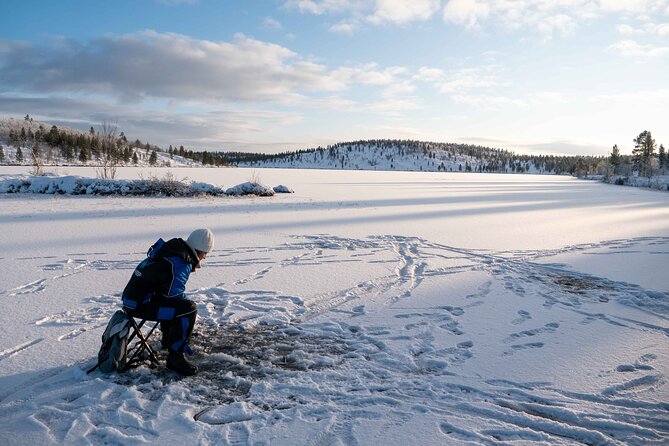
This is the kind of Lapland activity where the logistics are simple, but the setting is intense—in a good way. You meet at Xwander Nordic at Ivalontie 12 in Inari, and you’re aiming to arrive around 9:45 AM so you’re ready to start at 10:00 AM. The day runs about 5 hours, with the return back between 3:00 and 4:00 PM.
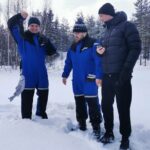
Before you even think about dropping a line, the crew outfits you with overalls and boots. That’s not a small detail. Arctic cold turns every delay into discomfort, and decent insulation means you spend your energy on what you came for: learning how ice fishing works, not just surviving it.
If you’ve never done anything on a frozen lake, you’ll notice two things fast. First, the ice is real—thick enough for drilling and net work. Second, the pace is calm. You move step-by-step with your guide, and you get a chance to watch the technique before you try it yourself.
You can also read our reviews of more tours and experiences in Lapland.
Drilling through thick ice: learning the real technique, not just a photo moment
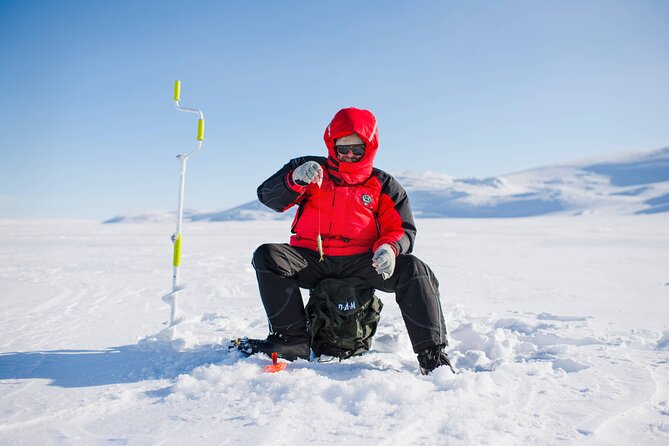
The day starts with ice fishing on the lake area connected with Lapland’s Inari region. You’re taught the traditional approach, starting with drilling through thick ice. That part is tactile and practical: you see the hole-making process, then you connect the hole to the next steps—how lines and nets work, how you wait, and how you interpret what you’re seeing under the surface.
There’s a big difference between ice fishing as a sport and ice fishing as a craft. Here, you’re not only trying to catch fish. You’re learning the logic of the system: the ice creates a working platform, and the submerged setup is what brings fish into play. That’s why the drilling isn’t treated like a stunt. It’s treated like the first tool in a whole method.
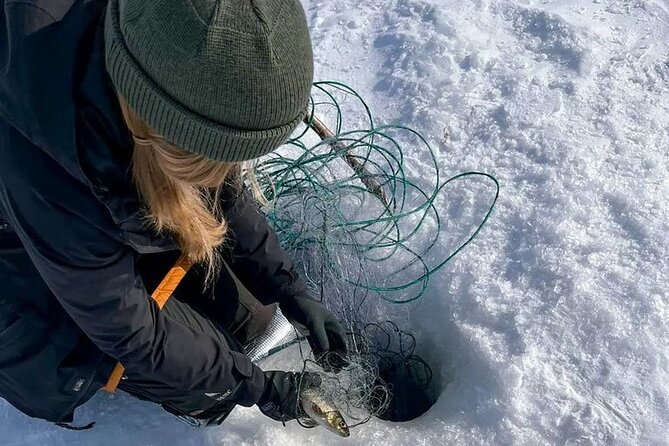
Then comes the net-check moment. You’ll learn how to work with submerged nets and what you’re looking for once fish are present. Even when you don’t land a big haul, the process teaches you how locals think about the lake: it’s not random luck, it’s observation and technique.
What you might catch: white fish, pike, perch, and burbot
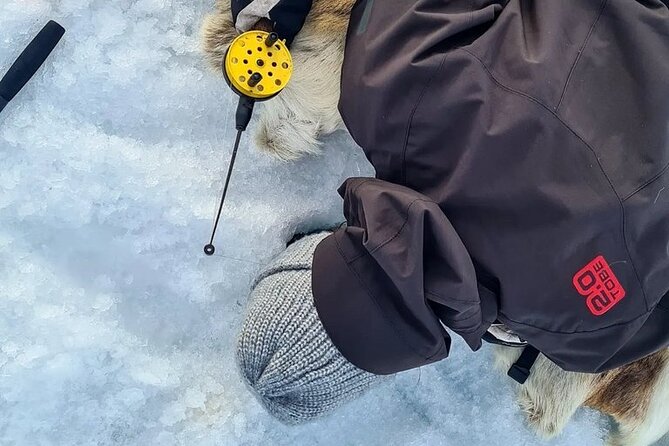
A key part of this experience is learning about Arctic marine life while you’re actively fishing. You’ll discover local fish species such as white fish, pike, perch, or burbot. That matters because it helps you connect your fishing effort to the local ecosystem instead of treating every bite as a mystery.
In real terms, this kind of knowledge makes the whole morning more engaging. When you understand which fish are in the system, you pay more attention to how the method changes depending on what’s showing up. And even if the fish you catch differs from what you imagined, you still leave with a clear story of what this lake can offer.
One useful detail: the fishing portion can include moments where equipment is in the mix in a hands-on way. For example, one real-world snag described during an ice fishing session involved a net getting stuck in the ice, and the guide worked through it with trial-and-error until fish were retrieved. That tells me the crew plans for reality, not just perfect conditions.
From catch to cooking: preparing your fish and learning at the same time
After the fishing and net work, you shift from catching to preparing. This is where the experience becomes more than sport. You’ll prepare the catch while learning about what’s going on below the ice and how the local approach fits together.
I like that the learning doesn’t feel like a lecture. It’s tied to what’s happening in front of you. If you’re the kind of person who gets bored when outdoors activities turn into speeches, you’ll probably appreciate this. Your guide is explaining the Arctic in a way that stays connected to the work.
Then comes the warm part: cooking.
Lappish Tipi Tent: fish soup and open-fire dessert that make the cold worth it
The day ends with a proper reward. In a Lappish Tipi Tent, you’ll cook and enjoy a warm fish soup made from what you catch. This is the heart of the experience: you trade the cold exposure for a meal you can actually taste the effort in.
A standout detail from the experience is the open-fire element. Dessert is also cooked over the fire, not just microwaved or pre-packed. That means the tent is lively and active, not just a place to sit and wait. You’ll feel the heat shift the atmosphere—from ice-clad focus to dinner-ready comfort.
Even better, this isn’t a tiny snack. It’s positioned as a full finish to the morning’s work, so you leave satisfied instead of just “having done an activity.” If your Finland trip includes outdoor tours, this is the one where you’ll likely remember the flavor, not only the photos.
The guides make it: Sonja, Juhanni, Ossi, and Jennifer’s style of teaching
Small group size—max 8—matters here. It means you get time with your guide, not just a quick instruction and then figure it out.
Across the guides you might meet, there’s a clear pattern: they’re skill-focused and patient, with a way of explaining Lapland that’s not limited to fishing alone. In past sessions, guides like Sonja, Juhanni, Ossi, and Jennifer have been praised for mixing practical fishing knowledge with cooking skills and real local context, including Sami culture.
One extra element that can catch you off guard (in a good way): the guides tend to bring energy beyond chores. In at least one description, the team covered more than technique—singing, navigating, and even helping with sled towing skills showed up as part of the broader competence you’re getting in the day.
You can treat that as entertainment, but it also signals something practical: when the crew is comfortable with the whole Arctic environment, your day runs smoother. Less stopping, more time learning and eating what you came for.
Timing and transfers: how the day flows from Inari and Ivalo
The day is built for a half-day experience, not an all-day marathon. You start around 10:00 AM, and you’re back by 3:00–4:00 PM. That’s ideal if you want Lapland without losing your whole day to logistics.
Transfers are included from Ivalo and back. You’ll also start at Xwander Nordic at the Ivalo/Inari meeting area (Ivalontie 12). What’s not included is supplementary transfer from places like Inari, Nellim, Kakslauttanen, Kiilopää, and Saariselkä. That doesn’t mean you can’t go—just that you may need to handle extra legs if you’re staying farther out.
In my experience, timing like this is what makes Arctic activities actually work. Too many tours in cold climates try to stack too much into one day. Here, the structure is straightforward: gear up, fish, prepare, cook, eat, return.
Price and value: what you get for about $188 per person
At $188.09 per person, the price can look steep at first glance—until you map it to what’s included. You’re paying for guided ice fishing instruction, fishing equipment, food and drinks, plus transfers from Ivalo and back.
That combination is usually where value shows up in Lapland. You’re not organizing cold-weather gear on your own, and you’re not figuring out how to access the fishing setup. The crew supplies the equipment, runs the instruction, and provides a full warm meal experience inside a tipi tent setting.
Also, the small group size helps justify the cost. When there are only up to 8 people, the guide attention is less diluted. You’re more likely to get hands-on help with drilling technique, net checking, and cooking steps.
If you’re traveling with a group, this tends to get even better because your tour experience doesn’t fragment into separate mini-plans. Everyone stays on the same schedule.
Optional add-ons: tent sauna and ice swimming
This tour can also end with extra bravery: tent sauna or ice swimming. These are listed as optional activities, meaning they come with an added cost beyond the base session.
Should you consider them? If you want the full Lapland contrast—cold ice lake energy followed by heat in a tent—these add-ons can make the day feel more complete. But if you’re already sensitive to cold or you’d rather keep the experience comfortable, skipping the extras still leaves you with a strong core: ice fishing + open-fire cooking.
Either way, you’ll want to listen to your guide. Cold-weather safety matters, and in Arctic environments, the person leading you tends to know what’s realistic given weather and conditions.
Who should book Arctic Fishing & Open Fire Cooking?
This tour fits best if you want a genuine Arctic skill experience, not just a scenic stop. I’d point you toward it if you like hands-on activities—especially ones where the payoff is food you helped prepare.
You’ll probably enjoy it if:
- You want ice fishing technique with guidance, not a do-it-yourself setup
- You care about learning local context while you work (Arctic marine life and seasonal knowledge)
- You like the idea of finishing with warm fish soup and open-fire dessert
- You prefer smaller groups (max 8) where questions don’t get lost
If you’re traveling only for city-style highlights, this may feel too outdoors-focused. If you’re okay trading comfort for a real Arctic day that ends warm, it’s a strong match.
Quick practical tips before you go
Even with overalls and boots provided, you’ll be happier if you think about staying warm the whole time. Wear layers that you can move in, and focus on comfort over fashion.
Also, go with the mindset that the day depends on conditions. The experience requires good weather, so if skies are rough, plans can change. That’s normal in Lapland. Better to treat it as part of the Arctic experience than as a surprise.
Finally, plan to bring your appetite. This isn’t a light snack at the end. It’s a warm, satisfying finish built around what you caught.
Should you book it? My straight take
If you want one Lapland experience that combines ice fishing, real cooking, and local guide knowledge, this is the kind of tour I’d put near the top of your list. The biggest reason: the day pays you back. You fish, you prepare, you eat—inside a Lappish Tipi Tent with open-fire warmth.
Book it if you’re excited by outdoors time and you don’t mind that weather is part of the deal. Skip it only if you’re looking for a more indoor or low-exposure activity, because this one is built around the ice.
FAQ
What is the duration of Arctic Fishing & Open Fire Cooking?
The tour lasts about 5 hours.
Where does the tour start and end?
It starts at Xwander Nordic, Ivalontie 12, 99800 Inari, Finland, and it ends back at the meeting point.
What time does the activity begin?
The start time is 10:00 AM, with arrival recommended around 9:45 AM.
Is the tour offered in English?
Yes, it’s offered in English.
What’s included in the price?
The included items are guide services, fishing equipment, food and drinks, and transfers from Ivalo and back.
What optional add-ons are available?
Optional add-ons include tent sauna and ice swimming.
What transfers are not included?
Supplementary transfers from Inari, Nellim, Kakslauttanen, Kiilopää, and Saariselkä are not included.
How many people are in a group?
The maximum group size is 8 travelers.
Is there a weather requirement?
Yes. The experience requires good weather. If canceled due to poor weather, you’ll be offered a different date or a full refund.
What is the cancellation window?
You can cancel for a full refund up to 24 hours in advance of the experience’s start time.